Showing posts with label lime. Show all posts

Wednesday, January 19, 2011

Roasted poblano and corn soup

018-crop v1

Every New Year’s Day our home calls for a gathering of family and friends.   After the detritus from fireworks has been swept away and our minds have cleared of the bubbly imbibed the night before, those closest to me trickle in for a low-key celebration to welcome the start of a new calendar year.  The stars of the meal are invariably Krofne - Serbian doughnuts.  Sweet and yeasty, they symbolize growth, abundance and everything good from the first day on.   While the yeast dough is rising and the kids wait patiently for the first batch of krofne to come out of the fryer, we indulge in a variety of soups.   In the old country soup is consumed almost every day and is an integral part of the main meal.   A clear thin broth at the start stimulates the appetite for heavier courses to follow.

In our new homeland, there are heartwarming and nourishing favorites that make an appearance every New Year’s Day – my sister’s Chicken Tortilla Soup from Stop and Smell the Rosemary;  Wild Mushroom Soup - a thick and creamy combination of wild and cultivated mushrooms always laced with sherry, port or Marsala and sometimes finished off with dried porcini powder; and Debbie’s Potato Soup that I learned to make during a ski trip to Utah several years ago. 

Since I love to change things up and can’t leave well alone (a common complaint of favorite husband!) I introduce a couple of new soups every year.  This year I made a Root Vegetable Soup including rutabagas and parsnips and a Roasted Poblano and Corn Soup.   Both were very well received!

My personal favorite this year was the Roasted Poblano and Corn Soup.   I come from a food culture that takes its peppers very seriously.  Every fall a haze blankets the old country and excites the senses with its sweet-smoky aroma.  Caused by the rising smoke of roasting sumptuous red peppers, families gather to make and can this distinctive relish known as ajvar.   It is a labor-intensive but much loved tradition.   Ajvar defines our cuisine and is eaten daily throughout the year. 

Living in Texas and in close proximity to Mexico has been a boon for me when it comes to food.   I think it’s safe to say that much of Mexican cuisine includes the use of an enormous variety of peppers.   Native to South and Central America, peppers were introduced to southeast Asia hundreds of years ago and spread throughout the world during the spice trade.   The poblano pepper has been my favorite pepper for many years now.   Far more complex in taste than your common green bell pepper, the poblano chile can range in heat from mild to hot.   My Roasted Poblano and Corn Soup will be as spicy as the heat intensity in the poblano peppers dictate.   In my mind, the higher on the poblano range of the Scoville scale the better!  

The poblano pepper’s firm walls and pseudo heart shape lends itself well to being roasted and stuffed as in Chiles en Nogada and Chiles Rellenos.   Poblano chiles are a bold contrast to avocados in my favorite omelette and add crunch to a flavorful chicken salad.    When dried, the poblano chile is called an ancho chile, a key ingredient of Mexican mole. 

Poblano peppers under the broiler.   Roasting the peppers imparts a smoky flavor and intensifies the heat:

012 v1

As you can see the skin has already separated from the flesh and is very easy to peel:

016 v1

Corn, another ‘new world’ wonder, adds sweetness and balance to the heat:

Roasted Corn 009 v1

The soup before it is blended:

011 v1

Roasted Poblano and Corn Soup  loosely adapted from a recipe by M.S. Milliken & S. Feniger

Serves 6

9 – 10 poblano chiles, about 2 pounds

2 ears or fresh corn, husks intact, silken ends trimmed

1 quart milk (I used 1% but any other milk will do)

1 tablespoon cumin seeds

1 bay leaf

1/4 cup olive oil

1 medium onion, diced

2 large cloves garlic, minced

½ -1 teaspoon ground cumin

2 cups chicken stock

chopped chives, cilantro, sour cream and lime segments for garnish, optional

To roast the poblano chiles and corn you may grill or broil them – the choice is yours. Preheat the broiler in your oven or fire up your grill. Grease the poblanos by dipping your fingers in a little oil and rubbing them all around. Place poblanos and corn about 5 inches below the broiler or on the grill. Roast until charred on all sides, turning every few minutes. Place roasted poblanos in a bowl or paper bag. Cover and allow them to steam for about 15 minutes. Now clean them but do not run them under water to rinse them. You will lose their flavorful juices if you do so. Carefully peel the skin off the poblanos. Pull the stem off but be careful not to burn your fingers as the steam escapes.  Split the poblanos in two lengthwise. Remove the seeds and discard. Chop coarsely and place in a bowl with any juices that they may have released. When the corn husks are charred on all sides, remove them from the broiler or grill and cool. Remove husks and silk and cut kernels off with a knife. Place in a bowl with the chopped poblano peppers. Set aside.

Infuse the milk by placing it in a medium saucepan with the cumin seeds and bay leaf. Place over medium heat and bring to a bare simmer but do not boil. Remove from heat and let sit for 20 minutes.

Heat the olive oil in a large saucepan over medium heat. Add the chopped onion and sauté until starting to brown, about 10 to 15 minutes. Add the garlic and ground cumin and cook, stirring frequently, for about 5 minutes. Then stir in the diced poblanos and corn kernels and continue to cook over low heat for 5 more minutes.

Using a sieve, strain the infused milk into the corn and chili mixture. Add the chicken stock and bring to a slow simmer over low heat. Simmer gently for 15 minutes.

To puree the soup you can use an immersion blender and puree to the consistency of your liking. You can also cool the soup for about 20 minutes (to prevent possible explosion of soup) and pour it into a food processor or blender to puree it. Pour it back into the soup pot to warm before serving.

Serve hot with sour cream, chives and cilantro as garnish and a squeeze of few drops of fresh lime juice.

025 v2

Prijatno!

Wednesday, June 30, 2010

Grilled corn (esquite) with black beans, lime dressing and queso Cotija

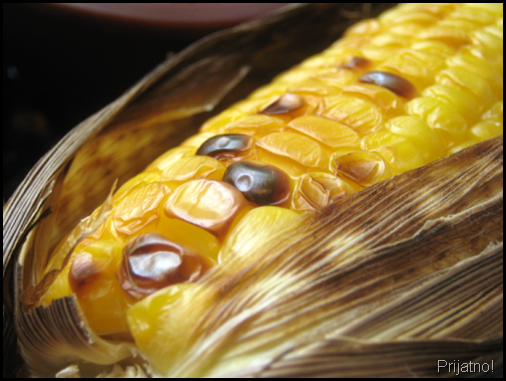
024 v1One of my favorite aromas is grilled sweet summer corn emanating from Hispanic food stands and taco trucks.   Smoky and hot with the presence of a little char, roasted corn on the cob is becoming a common street food here in Texas as it is in Mexico.  Known as elote, corn is usually roasted in its husk.  When stripped but left attached at the end, the husk (also known as the shuck) becomes the handle with which one eats the corn.   Slathered with mayonnaise, lime and chili powder, it is one toothsome treat!

Cinco de Mayo Roasted Corn 009 v1

Elote that has been cut off the cob are called esquites, and that’s what I served my delightful bunco group at my Cinco de Mayo feast this year.  Served with traditional Mexican accompaniments of mayonnaise, lime juice, chili powder, cayenne pepper and Cotija cheese, I took my esquites one step further by adding black beans and scallions.   It was very well received!

Roasted corn (esquites) with black beans, lime dressing and queso Cotija

4 ears corn, husks on

½ – 1 can black beans (14-oz), rinsed and drained

2 scallions, chopped

Lime dressing (see below)

1/3 cup queso Cotija (Cotija cheese), crumbled

To roast the corn: Soak corn with husks intact in cold water for 30 minutes. Drain water and pat dry. Broil or grill corn, turning every few minutes, until the husks char and corn kernels are cooked but still firm, about 12 – 18 minutes depending on the intensity of the heat. Cool and remove husks. Cut kernels off the cob and place them in a bowl.

Add black beans, scallions and lime dressing. Toss to combine and top with crumbled Cotija cheese and sprig of cilantro.

Lime dressing:

1/3 cup mayonnaise (sour cream or yogurt would be fine as well)

2 teaspoons freshly squeezed lime juice

¼ teaspoon chili powder, or a little more to taste

¼ teaspoon cayenne pepper

¼ teaspoon cumin

¼ teaspoon salt

Combine sour cream or mayonnaise, lime juice, chili powder, cayenne, cumin and salt in a small bowl.  Set aside. 046 v1

 Prijatno!

Thursday, June 17, 2010

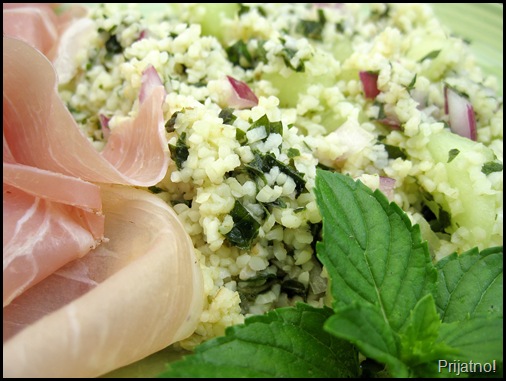
Tabbouleh with mint, honeydew melon and prosciutto

027 v2

Whether you spell it tabbouleh, tabouleh, tabouli or even tabuli, you will love this light and fruity version!  A staple in the Middle East, tabbouleh is a cold salad often found on meze plates.  Tabbouleh is made with bulgur, a whole grain wheat that has been parboiled, dried, crushed and sorted by size.  It is very high in fiber and protein and a perfect food for those watching their calorie intake - i.e., someone like me! 

I have recently formed a Biggest Loser contest with 16 of my lovely friends with the hopes of shedding the twenty, yes 20, or so pounds that I have gained since starting my blog!  The effect of sitting in front of a computer for hours on end and ingesting more calories than my typing fingers can burn has shown its ugly side.  Yeast dough, chocolate ganache, and the pleasing glass of wine in hand while I cooked will be replaced by healthier options until such time as I win this thing…and that bundle of money to be awarded!   (I am normally not very competitive but I seem to be showing my ugly side so let’s get back to tabbouleh…after all, this is a food blog and I have a job to do!)

With temperatures well into the 90’s here in Texas, tabbouleh is the perfect summer salad because stovetop heat is not needed to cook it.   It rehydrates and softens within 30 minutes with the simple addition of cold water.   Available in most grocery stores, bulgur comes in different sizes and ‘fine’ (#1) bulgur is the choice for tabbouleh. 

My garden is about to be overtaken by mint and I have been thinking of ways to use it in the kitchen.  Here it replaces parsley, the traditional herb of choice in tabbouleh.  I have never been a fan of cucumbers so they’ve been tossed for flavorful honeydew melon…and since melon and prosciutto go hand-in-hand I guarantee that you will love a few thin slices with the salad.

You may be questioning my choice of honeydew melon over one with less sugar (cantaloupe).   A girl’s got to get her vitamins and honeydew melon is very high in vitamin C and potassium.  Surprisingly, it’s high water content results in only 60 calories per cup!

015 v1

Tabbouleh with mint, honeydew melon and prosciutto

Adapted from Gourmet, July 2006.  Original recipe by Melissa Roberts-Matar

1 cup cold water
¾ cup fine bulgur (5 oz)
1½ cups loosely packed fresh mint leaves
1/3 cup extra-virgin olive oil
3 tablespoons fresh lime or lemon juice
1½ cups diced firm, ripe honeydew melon
½ cup finely chopped red onion
½ teaspoon salt

¼ pound thinly sliced prosciutto

Pour water over bulgur in a bowl.  Let stand for 30 minutes.  Drain in a sieve if there is water at the bottom of the bowl.

Place mint, oil and lime or lemon juice in a blender or food processor.  Blend until the mint is finely chopped but still has some distinguishable pieces.

Toss bulgur with mint mixture, honeydew, onion, and salt.  Refrigerate for at least an hour before serving.

Serve with prosciutto.  Serves 4.

 013 v1

Prijatno!

Thursday, April 8, 2010

Sautéed fresh garbanzo beans

030 v1

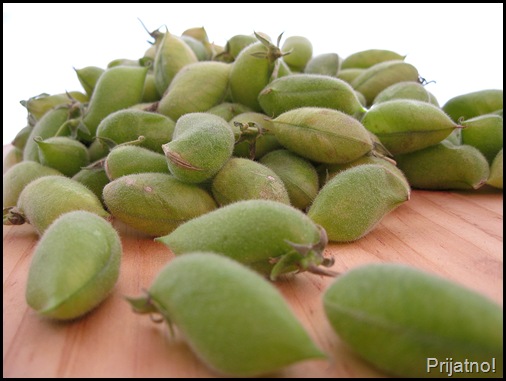
If you blink at the wrong time during early spring, you may miss the fleeting presence of fresh garbanzo beans, still in their small, fuzzy green pods.   Also known as chickpeas, ceci beans, Indian peas, Bengal gram and Kabuli chana, we are much more familiar in the US with garbanzos in canned or dried forms before they become the key ingredient in hummus, falafel, Indian vegetarian curries and Italian salads. 

I first spied fresh garbanzos as recently as last year.   Popping the beans out of their pods and savoring their green, sweet, and slightly nutty essence transported me far from the hectic, crowded city to a spacious country porch, a rocking chair and visions of me shelling garbanzos…I was well on my way to eating the entire bag by the time I arrived home!   Similar to green pea pods but smaller, their shells are thinner, hairy and paper-like.  One or two peas occupy each pod.  This picture shows how they are sold at markets in Mexico - fresh pods still attached to their branches.  The leaves are used to make sun tea and the branches are fed to the burros!   In the US you will pay a little more since you’re only buying the pods.   If you a lucky enough to come across some at your market or grocery store, grab some! 

This is how I found them

023 v1

Sadly, most of the crops in California support the dried garbanzo market.   Hopefully, with more families embracing a farm-to-table approach to their diets, these wonderful legumes will become a seasonal staple .   I recently read about a California farmer and his support of his Hispanic foreman’s “agricultural fantasy” - selling fresh garbanzos to “Gringos”!  When they introduced them at a market in San Francisco, Hispanic women delighted in the fresh crop, while the “Gringas” were not so easily charmed, especially put off by the chilling thought of, heaven forbid, shelling the beans themselves!!!  (Link to the entire article).     For people as particular as they are, sautéing them in their shells as I did below saves shelling time and they can be eaten like edamame – each person shelling his or her own.

In Mexico and from the Eastern Mediterranean to India, fresh garbanzos are eaten raw as well as cooked, and in many areas they are considered the poor man’s protein.  Aside from being high in protein, these nutritious little gems are also high in fiber and potassium .   My recent batch made it home with only a few beans eaten!   I decided to process them minimally so that they retain some of the raw “green” nutty taste that I hunger for.  A quick sauté did the trick for me, but you could also toss the pods in a little bit of olive oil and roast them at 425F for 25 – 30 minutes for a creamier texture.

055 v1

Heat a little bit of olive oil in a pan.  Carefully add the fresh garbanzo beans.  They will quickly begin jumping like popping corn!  

012v1

When the shells are charred on both sides, sprinkle with chile powder, cayenne pepper and kosher salt, to taste.  Finish with a squeeze of fresh lime juice.

058 v1

This simple snack is my entry to Magic Bullet To Go Giveaway, for which you can find details @ Fun and Food Cafe. You could win a Magic Bullet Food processor!  It’s easy!

Prijatno!

Sunday, April 4, 2010

Easter Babka

028 v1

This magnificent babka is a traditional Polish Easter bread that I made for my best friend’s annual Easter celebration.  Standing six inches tall, it is a slightly sweet yeast cake dotted with rum-soaked golden raisins and topped with a sweet lime glaze.  Rich in flavor thanks to 10 egg yolks, 2 whole eggs and melted butter, this babka is a fine way to break the Lenten fast!

Babka is the Northern Slavic word for “little grandmother”.  The bread is baked in a special pan that shapes the babka to emulate a full skirt covering the ample hips of a typical Eastern European grandmother.   The pan has ridges and curves suggesting the pleats and flowers of the fabric.  Unfortunately I don’t own a babka pan, so my large angel food cake pan became an acceptable stand-in.  

Thanks, Dorota for allowing me to make your babka this year!   Your Easter feasts are well-known and always a joy.

042 v1


Babka (adapted from Valinda’s recipe on Allrecipes)

1/3 cup rum, optional – if you want to soak the raisins*

3/4 cup golden raisins

1 cup milk or half-and-half

1/2 cup water

1 tablespoon sugar

2 1/2 (.25 ounce) packages active dry yeast

2 eggs, room temperature

10 egg yolks, room temperature

3/4 cup unsalted butter (1 1/2 sticks), melted and cooled but still warm

2 teaspoons vanilla extract

2 teaspoons lime zest

6 1/3 cup all-purpose flour, plus about 1 cup more for kneading

*If you want the raisins to be plump and delicious, soak them in the rum the night before or at least 2 hours before you start the recipe. 

Warm the milk, water and sugar until it reaches 110F (45C).    Add yeast and set aside for about 5 minutes.   Lightly oil a large bowl and set aside.   Drain raisins and enjoy the rum while you bake!

Stir 2 eggs, egg yolks, butter, vanilla and lemon rind in a large bowl of a mixer.   Using the paddle attachment,  mix in yeast mixture and raisins and beat well.   When a loose dough has formed, turn out onto a well-floured floured surface and knead until smooth, about 10 minutes, using the extra 1 cup of flour if necessary.   Place the dough in the oiled bowl and turn to coat on all sides with the oil.   Cover with a damp cloth and let rise in a warm place until doubled in volume, about 45 minutes.   Deflate the dough by punching it down and folding it over onto itself about 4 times.   Let rise again until doubled in volume, about 30 minutes.

Grease a babka pan or a large angel food cake pan.  Deflate the dough again and turn it out onto a lightly floured surface.   Shape it into a fat cylinder.  Place it into the babka or cake pan and fold over the ends.   Smooth the top with your hands until the dough is evenly dispersed.   Cover the pan with a damp cloth and let the dough rise until tripled in volume, about 40 minutes.  Meanwhile, preheat oven to 375F (190C).

Bake in preheated oven 10 minutes. Reduce oven temperature to 325F (165C) and bake for 30 minutes more. Reduce oven temperature to 275F (135C) and bake for another 15 to 20 minutes, until golden brown.   Let babka stand 5 to 10 minutes before removing from pan and cooling on a rack.

The Icing

2 cups confectioner’s sugar

2 tablespoons milk

1 teaspoon lime zest

1 tablespoon lime juice

1 teaspoon vanilla

Mix above ingredients together.  Add more milk or sugar to achieve a pouring consistency.  Pour over the warm babka. 

047 v1

Peace and joy as we celebrate our Lord’s resurrection today! 

Hristos voskrese!

Prijatno!

Thursday, February 18, 2010

Meze (Mezze)

032 v1-crop v2

Meze (Serbian), mezze (Arabic), and mezé (Greek), are the Eastern Mediterranean appetizers similar to Spanish tapas.  Derived from the Persian word maze ‘to taste or snack’, meze consists of plates that are a feast for the eyes.   Small bites and dips that are varied in texture, flavor and color, in my native Serbia they are traditionally served with rakija (fruit brandy).  

Of all the Slavic nations, the Southern Slavs are the most hospitable…believe me, I’m not partial…and there is no better way for them to demonstrate their warmth and generosity than through an offering of food.  Even unannounced guests are treated like family, and there is always more than enough to go around come see my parents’ leftovers sometime!   Serbian meze may include pršut (prosciutto), salama, kobasica (sausage), kajmak (clotted cream) and ajvar (red pepper relish).   For the sake of this Daring Kitchen challenge and our hostess, I am keeping it vegetarian with Middle Eastern mezze.   

My friend Chantal and I spent an enjoyable day baking pita bread and bringing the meze plates together.  She has an interesting collection of dinnerware  – many choices for the amateur photographer!  Just look at those pretty yellow ‘triple bowl’ dishes above.    Adorable, and perfect for meze!

In the  picture above you will find (counterclockwise from the top):  sliced radishes, kalamata olives, walnuts, preserved limes (I just happen to make a jar with Mexican key limes a couple of months ago), hummus with olive oil and a sprinkling of paprika, cucumber raita, hummus again, and pita bread.  Feta cheese cubes are in the middle.

DBKitchen logo The 2010 February Daring Cooks’ challenge was hosted by Michele of Veggie Num Nums.  Michele chose to challenge everyone to make mezze based on various recipes from Claudia Roden, Jeffrey Alford and Naomi Dugid.

The second plate below (from the top) consists of my favorite dip of all muhammara (I will post the recipe soon), pita bread, potatoes with olive oil and lemon zest, and yoghurt cheese sprinkled with dukkah (a blend of sesame seeds, spices and nuts).  Be forewarned:  there are healthy quantities of fresh garlic in the dips and falafel.  So much so that Husbie and I were able to created enough fumes to ward off the vampires and every disease under the sun for a few days now! 

007-crop v1

Pita Bread

Adapted from Vefa’s Pita Bread, found at Kalofagas

Serves 8

2½ cups all-purpose flour

1 tsp. salt

3/4 cup warm (body temperature) water

2 Tbsp. olive oil

1 Tbsp. active dry yeast

1 tsp. sugar

coarse cornmeal for dusting the dough

vegetable oil for greasing the pan

Combine the flour and salt in a large bowl. In a smaller blow, combine the warm water, olive oil, yeast, and sugar and let stand for five minutes or until you see that the yeast is active.

Using your hands, gradually add the wet ingredients into the dry ingredients and knead with your hands until the dough pulls away from the sides of the bowl. Cover and leave in a warm spot to rise and rest for about 30 minutes.

Divide dough into six pieces and roll out into 6 - 8 -inch rounds that are about 1/4 inch thick. Dust both sides lightly with cornmeal and poke the surface of your pita breads with the tines of a fork. Stack the dough rounds until you are ready to cook the pita bread.

Place a heavy cast-iron skillet (non-stick pan is fine) and heat to medium-high. Pour a little vegetable oil in the skillet and brush to cover the bottom. Carefully place one pita dough in the hot skillet. Cook for about 3 minutes and turn over when you see bubbles forming in the bread.

Place fried pita breads on to a large cotton kitchen towel and cover. Repeat with the rest of the dough, stacking them as you go. Serve warm with falafel or cut into triangles with the various dips and meze.

016-crop v1

Cucumber Raita

adapted from The Indian Grocery Store Demystified by Linda Bladholm

1 medium cucumber, peeled and most of the seeds removed
¼ teaspoon ground cumin
2 cups plain whole milk or Greek yogurt
1 garlic clove, peeled and minced
fresh coriander and/or mint, chopped, to taste

cayenne pepper or paprika, for the garnish (optional)

Dice the cucumber. Blot off excess moisture with paper towels.
Add cumin, yogurt, garlic, coriander and/or mint. Chill until ready to be served. Sprinkle with cayenne or paprika before serving.

Serve with falafel (above) or pita bread as part of meze (below).

008-crop v1 

Yogurt cheese sprinkled with Dukkah

To make yogurt cheese, line a medium sieve with two to four layers of cheesecloth (this depends on the weave:  more layers for a loose weave, fewer layers for a dense weave).  Place the sieve over a bowl.  Spoon 2 cups of plain whole milk or lowfat yogurt on the cheesecloth.  Cover with the excess cheesecloth and refrigerate overnight.   When ready to serve, unmold and sprinkle with dukkah.  Serve with pita bread triangles.

Dukkah

Adapted from Claudia Roden's book, The New Book of Middle Eastern Food and found on Michele’s blog with my adaptations in italics.

1 cup sesame seeds    I made half a recipe, 1/2 cup sesame seeds
1 3/4 cups coriander seeds   I added 2 tablespoons
2/3 cups blanched hazelnuts   I used 1/3 cup raw almonds
1/2 cup cumin seeds   I used 2 tablespoons cumin seeds
1/2 teaspoon salt 
1/4 teaspoon pepper
Put each variety of seeds and nuts on a separate tray and roast them all in a preheated 350F oven for 10-20 minutes, until they just begin to color and give off a slight aroma. As they take different times, you must keep an eye on them so that they do not become too brown, and take each out as it is ready. You could also roast them in a frying pan. Put them together in the food processor with salt and pepper and grind them until they are finely crushed, but be careful not to over-blend them into a paste.
To serve, sprinkle a little dukkah on the yogurt cheese or pour a little oil on small slices of bread and sprinkle with the dukkah.

038-crop v1

For the hummus, falafel and preserved lemon recipes, please go to Michele’s blog.

This post will be submitted to Susan’s blog Wild Yeast, for her weekly showcase of yeasted foods: YeastSpotting!

Prijatno!

Friday, February 12, 2010

Chicken salad with the flavors of Mexico

072 v1

This chicken salad was inspired by the purchase of a good-looking jicama!   Firm to the touch and tight-skinned, it was perfect for the taking and going to shine in a Mexican flavored salad I was already composing in my mind.   Delicious raw or cooked, its crunchy white flesh has the texture of a firm pear.  Slightly sweet on the tongue, the flavor hints of apple and pear.   

The jicama (hick-u-ma) is the root of a legume that is related to the potato and is easily found in Texas stores.  In Mexico and further south it is commonly served by street vendors with a little lime juice and a dusting of chili powder.  When cut into wide strips it can be a healthy replacement for chips – a means to scoop up a guacamole or salsa.  In my chicken salad, it adds a mildly sweet crunch and replaces celery handily. 

 056-crop v1

Composed mostly of water and very high in fiber and vitamin C, it’s the perfect diet food.  Look for jicama that are hard with tight, dry skins; a flattened ball shape, few bruises and no mold.  Pick the smaller ones (1.5lbs – 2.5lbs) as the larger they get, the higher the chance are of them tasting woody.  

Chicken salad with the flavors of Mexico

Serves 4

The marinade:

¼ cup fresh lime juice

¼ cup oil (I used olive oil)

½ teaspoon salt

freshly ground black pepper

2 chicken breasts

The dressing:

¼ cup mayonnaise

2 teaspoons fresh lime juice

¼ teaspoon cumin

¼ teaspoon chili powder

½ teaspoon salt

The veggies:

1 poblano pepper, roasted, peeled, seeded and diced; or left raw, seeded and diced

1 4-oz jar pimento peppers, drained

½ red onion, finely chopped

¼ cup green olives, sliced

1 cup jicama, peeled and diced

¼ cup cilantro, chopped

1 fresh jalapeno or 1 tablespoon pickled jalapeno, chopped, optional – for added spice

1 avocado, peeled and cut into cubes

lettuce leaves or toasted bread for sandwiches

Mix marinade ingredients in a medium bowl until well combined. Add chicken breasts and marinate for 30 minutes while you prepare the rest of the ingredients.

Preheat oven to 350F. Transfer chicken to a roasting pan, cover with and roast for 30 minutes or until cooked. Cool and then chop into bite-sized pieces.

Combine the dressing ingredients in a small bowl and whisk until combined.

062-crop v1

Place chicken, poblano pepper, pimento peppers, red onion, green olives, jicama, cilantro and jalapeno (if desired). Add dressing and mix gently with a large spoon. Top with avocado and serve on a bed of lettuce leaves or in a sandwich.

066 v1

My friend, Debbie, and I enjoyed ours on a bed of lettuce leaves while my nephew, Jovan, loved his sandwiched between buttermilk bread. 

Prijatno!

Monday, February 1, 2010

Fish tacos with spicy pineapple salsa and red cabbage slaw

023-crop v2

Favorite son, Alex and his lovely girlfriend, Alyssa are quite an accomplished young couple.  Both will be graduating from a reputable university in May with degrees in Chemical Engineering and a B.A. and Masters in Accounting respectively, and Husbie and I will finally get a raise…whoop!  I recently received a text from Alex asking me that if they opened a cafe, would I ‘pastry chef it up?’  My initial response was absolutely, but first go and earn some money in the field that you have been studying for the past five years and then we’ll talk! 

The ‘kids’ are fast becoming very skilled in the kitchen that I step aside and watch in amazement and burst with pride as they pickle vegetables, brew beer, make mayonnaise from scratch, grill burgers with blue cheese sauce, make gyros and much more.   I guess I shouldn’t be so surprised since it’s sort of written in their genes!  Alyssa hails from a Louisiana family that takes it’s food very seriously.  Her mother, Rhonda is an excellent cook who can stuff a shrimp like no one’s business and make a hearty chicken and sausage gumbo that’ll make you want to slap ya’ mama!  I have never resorted to fast food as a means of sustenance for my precious children and am happy to see that their philosophy of eating includes an appreciation and respect for fresh ingredients that not only nourish the body, but also provide a healthy avenue for creativity.

025-crop v1

Alex’s interest in ethnic cuisines began in a Cuban restaurant.  At the age of two, Husbie and I watched in amazement as he polished off a bowl of spicy Cuban salsa without a flinch of an eye!  In junior high, he experimented with salsa concoctions and loved to share them with his classmates.  One such salsa was so spicy that it managed to agitate the entrails of an intrepid classmate that he had to leave class and go home; I sincerely hope he hasn’t been scarred for life!

Here’s a meal that Alex and Alyssa treated us to recently.  Inspired by Rhonda’s recipe, these fish tacos are easy to prepare and include a sunny tropical salsa, crunchy red slaw, buttery avocado slices and delicate tilapia.

032-crop v1

Fish tacos with spicy pineapple salsa and red cabbage slaw  Serves 4

8 corn tortillas, warmed. I found very good yellow corn and wheat flour blend tortillas from La Tortilla Factory in Santa Rosa, California. They didn’t crack when folded as many corn-only tortillas do. They are available at Kroger grocery stores (one of the few good things I can chime about that comes from this chain. Living in the ‘burbs comes with its own challenges, one of them being the lack of great stores!)

Red cabbage slaw (see recipe below)

Spicy pineapple salsa (see recipe below)

1 avocado, halved, pitted, peeled and sliced

4 pieces of tilapia, or other mild white fish

Coat tilapia in a little oil.  Season with salt, pepper, paprika and cayenne, to taste.  Just before you are ready to eat, broil the tilapia for about 8 minutes until just cooked.

Serve tilapia with warmed tortillas, pineapple salsa, avocado slices and red cabbage slaw.

009-crop v2

Red cabbage slaw

½ red cabbage, finely sliced

1 cup cilantro leaves

1/3 red onion, thinly sliced

4 tablespoons apple cider vinegar

2 tablespoons honey

2 tablespoons lemon or lime juice

2 tablespoons canola oil

Place sliced cabbage, cilantro leaves and sliced red onion in a large bowl. Mix vinegar, honey and lime juice in a small bowl.  While whisking quickly, add canola oil to vinegar mixture.  Add to coleslaw and mix thoroughly.

007-crop v1

Spicy pineapple salsa – this recipe calls for more than you’ll need for the tacos.  The rest makes a refreshing tropical dip when served with tortilla chips.

1 large can (20 oz) crushed pineapple in its own juice

1 cup cilantro leaves, lightly packed

2 tablespoons fresh lemon or lime juice

3 tablespoons rice wine vinegar

hot sauce, to taste.  Alex loves Sriracha brand to spice things up. 

Place all ingredients in food processor and blend.


002-crop v1

045 v1

This post was submitted to Susan’s informative blog Yeastspotting for this week’s edition.

Prijatno!

Friday, October 9, 2009

Mastering puff pastry and vols-au-vent

vol-au-vent 017-crop v2

Kitchens should be getting cooler in the northern hemisphere…says Steph innocently from her home in Sydney.  No such cooling took place in good old Texas in September, where temperatures were still reaching the 90’s and when I was supposed to post this Daring Bakers challenge.

I’ve baked with lots of purchased puff pastry in the past (“Mom, can you make pastries for breakfast today?”) but I have never taken the time to make it from scratch.  Now I remember why!  If you live in Texas, my friends, it’s an all-day process during the month of September!  We’re still struggling to keep our homes cool, so the conditions are not exactly conducive to a process that requires keeping the butter solid cold while you perform a series of turns which creates the flakiness of the dough.  Roll, fold, turn, chill and wait; roll, fold, turn, chill and wait again; roll… and so it went all day long.  The key to successful puff pastry is to keep the butter from playing hookie on your counter instead of being obediently enveloped in the dough while you’re rolling it.  A cool marble countertop cool to look at and cool to the touch would be sooo perfect for this project…note to self –  make sure you get at least one marble countertop for making pastries when you redo the kitchen!   

DBMiss Measure_v150x200I’m not a master yet when it comes to making puff pastry, but it was good enough to produce the vols-au-vent (literally “windblown” for its airiness), pictured above.  Vols-au-vent are typically served hot and are filled with a creamy savory filling.  I filled them with a chilled fresh Crab Salad –  who wants to heat up the stove in 90 degree weather?  

The September 2009 Daring Bakers' challenge was hosted by Steph of A Whisk and a Spoon. She chose the French treat, Vols-au-Vent based on the Puff Pastry recipe by Michel Richard from the cookbook Baking With Julia by Dorie Greenspan.  Thanks Steph for organizing the challenge and thanks to Lis and Ivonne for rocking the Daring Bakers every month with their cool challenges!

…

Vols Au Vent:
Michel Richard’s Puff Pastry Dough
From: Baking with Julia by Dorie Greenspan
Yield: 2-1/2 pounds dough.  If you are interested in making your own puff pastry and/or vols-au-vent, please click
here to see the recipe and a detailed explanation.  Also included are helpful instructional videos.  The selected instructions below describe my pictures only.

Place the block of cold butter (the beurrage) in the middle of the dough (the détrempe) and fold the ears over the butter, stretching them as needed so that they overlap slightly and encase the butter completely.  This dough/butter packet is called a paton and is rolled and folded repeatedly (turning).fall veggies and vol-au-vent 030-crop v2

Then, keeping the work surface and the top of the dough well floured to prevent sticking, roll the dough into a rectangle that is three times as long as the square you started with, about 24" …With this first roll, it is particularly important that the butter be rolled evenly along the length and width of the rectangle; check when you start rolling that the butter is moving along well, and roll a bit harder or more evenly, if necessary, to get a smooth, even dough-butter sandwich (use your arm-strength!). fall veggies and vol-au-vent 043 v1

The total number of turns needed is six…However, no matter how you arrange your schedule, you should plan to chill the dough for at least an hour before cutting or shaping it. fall veggies and vol-au-vent 050 v2  
Bake the shells until they have risen and begin to brown, about 10-15 minutes depending on their size. vol-au-vent 003 v1 
Crab Salad  enough to fill about 12 vols-au-vent, but also good on a bed of lettuce!

1 pound fresh lump crabmeat (none of that rubbery imitation stuff, ok?)

¾ cup red bell pepper, finely chopped

2 shallots or ½ red onion, finely diced

2 jalapenos, finely diced

zest of 1 lime

juice of 2 limes

leaves of about 10 stems of cilantro, roughly chopped

1 tablespoon white wine vinegar

3 tablespoons extra virgin olive oil

salt and freshly ground black pepper, to taste

2 scallions, sliced thinly on the diagonal

Pick through the crabmeat to remove any scales.

Place red bell pepper, shallots or red onion, jalapenos, lime zest, lime juice, cilantro, vinegar and olive oil in a bowl. Whisk to blend. Add salt and pepper to taste.

Add crabmeat and gently mix it in. Top with scallions and serve with salad greens or in vols-au-vents.

vol-au-vent 012-crop v1

Prijatno!

Thursday, May 21, 2009

TWD Fresh mango (bread) muffins

TWD Mango cupcakes2

I was intrigued when I first found out that Fresh Mango Bread was the TWD (Tuesdays with Dorie) recipe for this week. I’ve made many banana, apple, cranberry, blueberry, carrot and even a zucchini bread, but mangos in a loaf never crossed my mind.

When I read the recipe, I suspected that the subtle flavor of one diced mango would not be very prominent in the bread, so I looked for ways to make it more mango-ey. And as my family already knows, in true Dragana fashion, I just had to put my twist to it: the raisins had to go – they’re way too pedestrian! What I found were delicious, sweet and intensely flavored dried mango pieces. To 1/2 cup of chopped dried mango, I added just enough rum to cover them. Later, I added 3 tablespoons of the soaking rum to the batter (I’m never in favor of discarding good liquor!). I reduced both the sugar to 3/4 cup and the ginger to 1 teaspoon – after all, it’s all about the mangoes, right? I came away with 12 moist and tasty individual muffins.

tuesdayswithdorielogo

Thanks to Kelly at Baking with the Boys for selecting this recipe. You can find the original recipe on her blog. After the TWD chocolate onslaught in April, this was a refreshing change. Topped with lightly sweetened whipped cream, diced crystallized ginger, freshly grated lime zest and a chunk of dried mango, these muffins are a winner! Just ask Carolina!

TWD Mango cupcakes1

Prijatno!

Tuesday, May 5, 2009

Cinco de Mayo!

linda landeros

Hola, dear friends!  Today many Americans of Hispanic heritage commemorate the victory of a small, ill-equipped Mexican army over a much larger and more sophisticated French militia at the Battle of Puebla.  The Batalla de Puebla took place on May 5, 1862.  Contrary to popular belief, Cinco de Mayo is not Mexico’s Independence Day (that being September 16, 1821).  It is not widely celebrated in Mexico but is a regional holiday limited to the state of Puebla.

The Darling Bakers are also celebrating Cinco de Mayo today!  Here’s how the holiday came to be:  darling baker Napoleon III was determined to collect a loan and expand his empire.  His troops landed near the coast of Veracruz and proceeded to march towards Mexico City.  Abraham Lincoln, sympathetic to the Mexican cause, could offer no assistance because he was involved in his own war, the American Civil War.  In Puebla, General Ignacio Zaragoza Seguin and his small militia were able to stop and defeat the French.  It was a sweet victory for a troubled country.

But that was not the end of the French!  Napoleon sent 30,000 (yes, thirty thousand!) more troops who eventually took over Mexico City.  His cousin, Archduke Maximillian of Austria became the ruler.  After the American Civil War, Lincoln provided more military assistance and Maximillian was executed in 1867.  That, in a nutshell is the story behind CDM.

That’s Linda Landeros in the picture above.  Landeros is a dance instructor and performer with many dance companies in the San Francisco Bay Area.  The colors in her dress express the spirit and vitality of the Mexican people.  In the US, particularly in the border states, Cinco de Mayo is celebrated with music, folklore dancing, art and of course food!

One of my favorite Mexican foods is grilled corn with a chili lime sauce.  I first came across it outside a local Hispanic grocery store called Fiesta.  The aroma of roasted corn wafted through the parking lot, leading me to a mobile kitchen where the vendor was slicing the kernels off the cob and into a styrofoam cup.  He topped it off with a delicious, spicy and creamy sauce.  My daughter and I just can’t resist this kind of street food!

Mexican grilled corn1 I broiled these in their husks.

Mexican grilled corn2

Quesedillas are also a favorite.  These are filled with crabmeat, roasted poblano pepper, roasted sweet red pepper, avocado, caramelized red onion, corn, cilantro, chili powder and Monterrey jack cheese.  I served them with my Cilantro Crema – sour cream, lime juice and chopped fresh cilantro. 

Crab quesedillas

This is how I like my cerveza:  ice cold and in an ‘O’ with lime.  Believe it or not, that’s the entire 12oz. bottle in there!

Cervesa1

Lime suspended in a golden brew:

Cervesa2

Mangos flameados comes from Diana Kennedy’s classic book The Cuisines of Mexico.  It’s a Mexican take on Bananas Foster crossed with crepes Suzette!  I served it with vanilla ice cream.   Mmmm….

Mango flammeado

These Mexican Nutella cookies are perfect with a cup of coffee.  You can serve them plain or with a dusting of powdered sugar.

Mexican nutella1

I leave you with a bite!   Adios!

Mexican nutella2 

Prijatno!