Showing posts with label walnuts. Show all posts

Wednesday, June 9, 2010

Onion Jam

029 v1

I have always loved the taste of jams and preserves.  What can be better than fruit cooked with a healthy dose of sugar?  A picky eater as a youngster -- oh, how things have changed -- bread, butter and jam kept this overactive, skinny little girl happy.  Peanut butter and jelly was an unheard-of combination in South Africa so my sandwiches were filled with salted butter and exotic berry jams, apricot, plum or my all-time favorite fig. 

I still enjoy my jam and butter but it’s more likely to be on a single piece of toast since the calories add up a lot quicker now :(    With the increase in availability of a wide variety of cheeses from all over the world and locally by our very own artisans (try Blue Heron Farm), a new way of enjoying preserves has emerged.   Chunky preserves can complement a pungent, rich cheese with its texture and sweetness;  fig jam is a perfect partner to tangy goat cheese.  

A mind-boggling array of delicious savory jams has emerged in recent years.  Chipotle peppers cannned with peaches or raspberries, ginger with figs, and blueberries with garlic are just a few that come to mind.  Here’s the simple recipe for Onion jam that I served with Walnut bread and Humboldt Fog chèvre (goat cheese) as seen in my previous post.  When cooked slowly, the onions are allowed to absorb the sugar, soy sauce, wine and vinegar.  Once the water in the liquids has evaporated the mixture becomes thick, jammy and complex in flavor…sweet, salty, a tad sour…umami... and perfect with chèvre. 

This savory jam would also be an outstanding accompaniment to a roast beef or turkey sandwich.  It would be delicious with a freshly grilled steak or on a vegetable pizza.  The thought of it mingling with melting queso in a quesadilla makes my mouth water!.  Get creative with it…it’s worth the 45 minutes or so of stirring!

Onion Jam from the Mustards Grill Napa Valley Cookbook

Makes about 1 cup

1 tablespoon extra virgin olive oil

2 cups sliced onions; I have used both yellow and red

2 tablespoons sugar

½ teaspoon soy sauce

1 tablespoons balsamic vinegar

2 tablespoons red wine

2 tablespoons water

Heat the olive oil in a skillet over medium heat. Add the onions and cook for 5 - 8 minutes until tender and translucent. Add the sugar and cook, stirring occasionally, for 15 - 20 minutes, until onions are golden brown. Add the remaining ingredients and cook, stirring often to avoid scorching, for about 20 minutes, until the mixture is thick and jam like.  Taste and adjust for salt, if necessary.  The slower you cook it, the richer the jam will become. Store tightly covered in the refrigerator for up to 2 weeks.

030 v1

Prijatno!

Wednesday, June 2, 2010

Walnut bread with Humboldt Fog goat cheese and Onion jam

024 v2

My love for goat cheese (chèvre) is no secret.  I am an afflicted turophile!  It’s a new word for me and probably for you as well, dear reader.  It comes from the Greek tyros ‘cheese’ and philos ‘love’ and was first used by the English in the 1930s.  Rarely used today, it also means ‘connoisseur of cheese’.   Aside from being a dedicated turophile, I also spend way too much time on the internet where I came across an alternative/rock band based in Toledo, Ohio named Turophilie, that claims to have “no tolerance for the lactose intolerant”!   I listened to a couple of songs on their playlist and quite like their sound.  Interesting stuff one comes across on the internet!

Back to chèvre…Hubby and I hosted a wine dinner recently with goat cheese or goat's milk in every single course.   For starters, and with the help of my accomplished wine group members, I managed to pack eight delicious tidbits on two appetizer plates.   Each of the items varied in texture, flavor and color and presented a feast for the eyes!

Warm appetizer plate

Tartelettes with chèvre, red peppers and caramelized red onions

Creamy Mediterranean chèvre polenta with scallops on a half shell

Dates stuffed with chèvre wrapped in bacon

Roasted beet and chèvre tower with pistachios

Chevre dinner 2-2010 hot app plate

Cold appetizer plate

Humboldt Fog on homemade walnut bread

Terrine of chèvre with zucchini and roasted red, orange and yellow peppers

Chèvre crème brulee with turbinado crust

Melon salad with chèvre feta and sherry vinegar dressing

Chevre dinner2 2-2010 cold app plate

Chèvre overkill, you say?  It can never happen in my world, but it was a definite challenge for Hubby in the wine pairing department.  Since a few members of our group tend to steamroll toward the reds, we had to remind them that goat cheese loves to be courted by champagne, Sauvignon Blanc and Riesling.   I managed to sneak some chèvre into the spinach and pine nut ‘cigars’ that accompanied the main course of grilled lamb chops with celery root and Yukon gold puree and sautéed mushrooms.   We drank a few Chateauneuf-du-Pape reds and everyone was very happy.   Homemade Vanilla bean goat’s milk ice cream topped individual apple tarts for dessert and we were ecstatic!

In my ‘humboldt’ opinion, Humboldt Fog chèvre rivals the best the French can produce.   Made in California by Cypress Grove Chèvre, it is the epitome of American made cheese.  It’s firm and chalky, thick and creamy, with an unmistakable tang derived from the acids unique to goat’s milk.  The rind is edible, as well as the delicate layer of ash that runs through the middle of the cheese, giving it a pretty layer-cake look.  Best at room temperature, the outer layer oozes creamy-rich decadence seen in the picture at the end of this post.

A nice complement to the chèvre is bread made with walnuts and shallots.   The soft rich cream in the cheese contrasts with a hint of onion and crunchy nuts.  It’s also great with Onion Jam, a recipe I’ll share in the next few days.   Here’s the bread…on bright red!

006-crop v2

Walnut bread

Adapted from The Cheese Course by Janet Fletcher

Makes one 8-inch round loaf

1 cup walnuts

¼ ounce package active dry yeast, or 2½ teaspoons instant yeast

1/3 cup warm water (110ºF to 115ºF)

1 cup milk

1/3 cup unsalted butter, cut up into chunks

about 3 cups unbleached all-purpose flour

½ cup whole-wheat flour

2 teaspoons salt

1/3 cup minced shallots

2 tablespoons cornmeal

1 pound Humboldt Fog cheese

Preheat oven to 350ºF. Toast walnuts on a baking sheet until fragrant and lightly toasted, about 15 minutes. Let cool and then chop coarsely.

In a small bowl sprinkle the yeast over the warm water and let stand for 2 minutes to soften. Stir to dissolve and allow to sit for about 5 – 10 minutes, or until fine bubbles form on the surface. This means that the yeast is active and you have just ‘proofed’ it.

Heat the milk and butter in a small saucepan until butter is melted. Set aside to cool to about 110ºF.

In a large bowl, stir together 1¾ cups of the all-purpose flour, whole-wheat flour and salt. Add the active (proofed) yeast, milk and butter mixture, shallots and walnuts. Stir until well blended. Add more all-purpose flour gradually, stirring until the dough becomes too stiff to stir. Turn out onto a lightly floured board and knead until the dough is smooth and elastic, about 5 minutes, adding more flour as necessary.

Shape the dough into a ball and transfer to a large greased bowl (I use about 1 tablespoon olive oil). Turn the dough over to coat the entire surface with oil. Cover with a clean kitchen towel and let rise until doubled, about 1½ hours. Punch the dough down and transfer to a lightly floured work surface. Reshape into a ball and transfer to a baking sheet dusted with the cornmeal. Cover with the towel and let rise until doubled, about 1½ hours.

Preheat oven to 425ºF. Put a baking dish with ice water on the floor of the oven to create steam. Slash the loaf a couple of times, and then bake for 30 minutes. Reduce the oven temperature to 325ºF, remove the water from the oven and continue to bake bread until it is well browned, about 30 minutes more. Let cool on rack before slicing.  Serve with sliced Humboldt Fog cheese and Onion Jam.

  032 v1

I am submitting this recipe to YeastSpotting, a weekly review of yeast-driven food.  Check the link for some wonderful recipes!

Prijatno!

Thursday, February 18, 2010

Meze (Mezze)

032 v1-crop v2

Meze (Serbian), mezze (Arabic), and mezé (Greek), are the Eastern Mediterranean appetizers similar to Spanish tapas.  Derived from the Persian word maze ‘to taste or snack’, meze consists of plates that are a feast for the eyes.   Small bites and dips that are varied in texture, flavor and color, in my native Serbia they are traditionally served with rakija (fruit brandy).  

Of all the Slavic nations, the Southern Slavs are the most hospitable…believe me, I’m not partial…and there is no better way for them to demonstrate their warmth and generosity than through an offering of food.  Even unannounced guests are treated like family, and there is always more than enough to go around come see my parents’ leftovers sometime!   Serbian meze may include pršut (prosciutto), salama, kobasica (sausage), kajmak (clotted cream) and ajvar (red pepper relish).   For the sake of this Daring Kitchen challenge and our hostess, I am keeping it vegetarian with Middle Eastern mezze.   

My friend Chantal and I spent an enjoyable day baking pita bread and bringing the meze plates together.  She has an interesting collection of dinnerware  – many choices for the amateur photographer!  Just look at those pretty yellow ‘triple bowl’ dishes above.    Adorable, and perfect for meze!

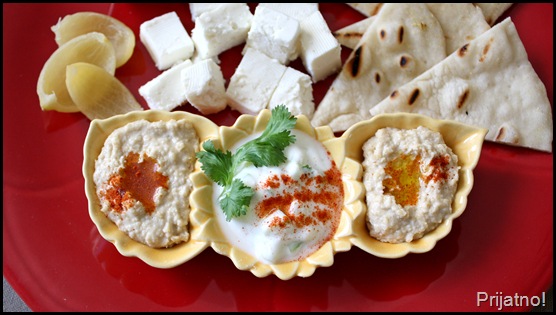
In the  picture above you will find (counterclockwise from the top):  sliced radishes, kalamata olives, walnuts, preserved limes (I just happen to make a jar with Mexican key limes a couple of months ago), hummus with olive oil and a sprinkling of paprika, cucumber raita, hummus again, and pita bread.  Feta cheese cubes are in the middle.

DBKitchen logo The 2010 February Daring Cooks’ challenge was hosted by Michele of Veggie Num Nums.  Michele chose to challenge everyone to make mezze based on various recipes from Claudia Roden, Jeffrey Alford and Naomi Dugid.

The second plate below (from the top) consists of my favorite dip of all muhammara (I will post the recipe soon), pita bread, potatoes with olive oil and lemon zest, and yoghurt cheese sprinkled with dukkah (a blend of sesame seeds, spices and nuts).  Be forewarned:  there are healthy quantities of fresh garlic in the dips and falafel.  So much so that Husbie and I were able to created enough fumes to ward off the vampires and every disease under the sun for a few days now! 

007-crop v1

Pita Bread

Adapted from Vefa’s Pita Bread, found at Kalofagas

Serves 8

2½ cups all-purpose flour

1 tsp. salt

3/4 cup warm (body temperature) water

2 Tbsp. olive oil

1 Tbsp. active dry yeast

1 tsp. sugar

coarse cornmeal for dusting the dough

vegetable oil for greasing the pan

Combine the flour and salt in a large bowl. In a smaller blow, combine the warm water, olive oil, yeast, and sugar and let stand for five minutes or until you see that the yeast is active.

Using your hands, gradually add the wet ingredients into the dry ingredients and knead with your hands until the dough pulls away from the sides of the bowl. Cover and leave in a warm spot to rise and rest for about 30 minutes.

Divide dough into six pieces and roll out into 6 - 8 -inch rounds that are about 1/4 inch thick. Dust both sides lightly with cornmeal and poke the surface of your pita breads with the tines of a fork. Stack the dough rounds until you are ready to cook the pita bread.

Place a heavy cast-iron skillet (non-stick pan is fine) and heat to medium-high. Pour a little vegetable oil in the skillet and brush to cover the bottom. Carefully place one pita dough in the hot skillet. Cook for about 3 minutes and turn over when you see bubbles forming in the bread.

Place fried pita breads on to a large cotton kitchen towel and cover. Repeat with the rest of the dough, stacking them as you go. Serve warm with falafel or cut into triangles with the various dips and meze.
016-crop v1

Cucumber Raita

adapted from The Indian Grocery Store Demystified by Linda Bladholm

1 medium cucumber, peeled and most of the seeds removed
¼ teaspoon ground cumin
2 cups plain whole milk or Greek yogurt
1 garlic clove, peeled and minced
fresh coriander and/or mint, chopped, to taste

cayenne pepper or paprika, for the garnish (optional)

Dice the cucumber. Blot off excess moisture with paper towels.
Add cumin, yogurt, garlic, coriander and/or mint. Chill until ready to be served. Sprinkle with cayenne or paprika before serving.

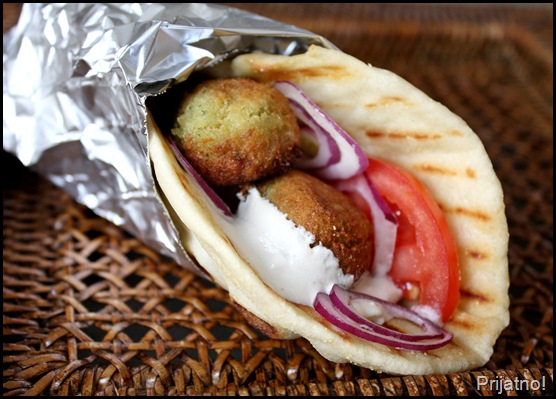
Serve with falafel (above) or pita bread as part of meze (below).

008-crop v1 

Yogurt cheese sprinkled with Dukkah

To make yogurt cheese, line a medium sieve with two to four layers of cheesecloth (this depends on the weave:  more layers for a loose weave, fewer layers for a dense weave).  Place the sieve over a bowl.  Spoon 2 cups of plain whole milk or lowfat yogurt on the cheesecloth.  Cover with the excess cheesecloth and refrigerate overnight.   When ready to serve, unmold and sprinkle with dukkah.  Serve with pita bread triangles.

Dukkah

Adapted from Claudia Roden's book, The New Book of Middle Eastern Food and found on Michele’s blog with my adaptations in italics.

1 cup sesame seeds    I made half a recipe, 1/2 cup sesame seeds
1 3/4 cups coriander seeds   I added 2 tablespoons
2/3 cups blanched hazelnuts   I used 1/3 cup raw almonds
1/2 cup cumin seeds   I used 2 tablespoons cumin seeds
1/2 teaspoon salt 
1/4 teaspoon pepper
Put each variety of seeds and nuts on a separate tray and roast them all in a preheated 350F oven for 10-20 minutes, until they just begin to color and give off a slight aroma. As they take different times, you must keep an eye on them so that they do not become too brown, and take each out as it is ready. You could also roast them in a frying pan. Put them together in the food processor with salt and pepper and grind them until they are finely crushed, but be careful not to over-blend them into a paste.
To serve, sprinkle a little dukkah on the yogurt cheese or pour a little oil on small slices of bread and sprinkle with the dukkah.
038-crop v1

For the hummus, falafel and preserved lemon recipes, please go to Michele’s blog.

This post will be submitted to Susan’s blog Wild Yeast, for her weekly showcase of yeasted foods: YeastSpotting!

Prijatno!

Thursday, January 7, 2010

Poppy seed and Walnut strudels for Eastern Orthodox Christmas

018-crop v1

Mir Božiji, Hristos se rodi!    The peace of God, Christ is born!  That is the greeting you will hear on January 7 across Serbia, other parts of former Yugoslavia and Russia.  Eastern Orthodox Christians remain the last holdouts against change of the theological calendar from the Julian to the Gregorian calendar.  Therefore, Christmas (Božić) comes two weeks after the rest of Christianity celebrates the birth of Christ.  Kids being kids, celebrating Christmas twice has never been a problem for our children who are products of an American father and a Serbian mother! 

046-crop v1So when everyone else is back to a normal schedule and on their first diet of the New Year, my parents are in full swing smoking meat and preparing the sour cabbage that has been fermenting for weeks for the sarme (cabbage rolls).  They also roast pork, and Mama makes a delicious Russian salad with chopped ham and vegetables . 

My job for Božić is to not forget to include the lucky coin in the česnica before I bake it!  The kids especially look forward to pulling their piece of bread from the česnica to see if it contains the lucky coin.  And this year I tried my hand at walnut and poppy seed strudels.  They are traditionally baked during the holidays and consist of a rich and buttery yeast dough with a sweet filling of nuts or poppy seeds.   Known as štrudle (pl.) in Serbia, these are also known as Beigli in Hungary, Potica in Slovenia, Povitica in Croatia, and Makowiec in Poland.  I am very pleased at how they turned out, having done a lot of research in books and on the web and finally combining several different recipes to create my own.  These strudels are very moist and can be eaten at any time of day.

Poppy seed and Walnut strudels.  Makes 4 12” rolls (2 walnut and 2 poppy seed)

For the dough:

1 1/2 teaspoons instant or rapid-rise yeast

5 1/2 cups all-purpose flour, plus more for kneading

1 1/2 cups milk

1/4 cup sugar

1 teaspoon salt

1 cup (2 sticks, 8 ozs) unsalted butter, cut into 1” pieces

6 egg yolks (the egg whites will be used in the walnut filling)

For the walnut filling:

1 1/2 pounds walnuts

1 1/2 cups sugar

1 tablespoon ground cinnamon

pinch of salt

1/4 cup (1/2 stick, 2 ozs) unsalted butter, cut into 1” pieces

1/2 cup milk

6 egg whites

For the poppy seed filling:

2 cans poppy seed cake and pastry filling (I use Solo brand).  Open them and you’re ready to go!

To make the dough and strudels:

In a large mixing bowl, combine yeast and flour.  Using a paddle attachment, blend the two ingredients at low speed.  Set aside.

Measure milk, sugar, salt and butter in a microwaveable measuring cup.  Heat in microwave at 30 second intervals until the butter is melted and the mixture measures between 110F – 120F.   On low speed, pour the milk and egg yolks into the flour mixture.  Beat until the mixture has formed a sticky mass and the ingredients have blended, about 2 minutes.  Turn the dough out onto a heavily floured surface and knead until smooth and elastic, about 8 minutes. Lightly oil a large bowl;  place the dough in the bowl and turn to coat with oil. Cover with a damp cloth and let rise in a warm place until doubled in volume, about 1 hour.   Because the dough is very rich with eggs and butter, it may even take up to 1 1/2 hours.

Line a large 12” x 18” baking sheet with a silpat or parchment paper (grease parchment with oil).  Turn the dough onto a generously floured surface.  Pat it down with your hands into a large rectangle (photo left). 

041 (2) v1034 (2) v1 

Cut the dough into two equal pieces.  Set one aside.  ***Roll one piece of dough to 1/4-inch thickness or 24” x 16”.  Spread with walnut filling up to about 1 inch of the edges (top right photo). 

046 (2) v1 v2048 (2) v1

Fold the 1-inch edges over the filling at both short sides (see pictures above).  Starting with one long side, roll the dough tightly to the other end, like a jelly roll.  Cut the roll into two equal 12” strudels.  Pinch the exposed ends to seal the filling inside.  Place each roll on the prepared baking sheet so that the long seams are on the bottom and the rolls fit crosswise on the sheets.  Space the rolls out (you will have 4) so there will be space in between rolls for them to rise.

Now take the dough that has been set aside and roll it out the same way (instructions start here ***).  Fill it with poppy seed filling.  Roll up as instructed above, cut into two and place on baking pan.  You should now have 4 rolls.

049 (2) v1

Cut a piece of wax paper large enough to cover the strudels.  Spray or grease one side with oil.  Cover the strudels and allow to rise until doubled in volume.  Gently spread the tops with a little of the beaten egg whites left over from the walnut filling.  Preheat oven to 350 degrees.

Bake at 350 degrees for about 60 minutes, or until the tops are golden brown.  Cool completely.  Slice into thin sections and using a sieve, dust with confectioner’s sugar.

To make the walnut filling:

Grind walnuts, sugar, cinnamon and salt in a food processor until finely ground.  Pour the mixture into a medium saucepan.  Add the butter and milk.  Over medium heat, stir the mixture constantly until the butter has melted and the mixture is starting to dry.  Remove from heat and allow to cool.

Beat the egg whites until they are stiff.  When the walnut mixture has cooled, add about 2/3 of the egg whites to it and fold gently with a spatula until completely combined (you will use the rest of the whites to spread the tops of the strudels before you bake them).  Use this filling as stated above. 

037-crop v1 052-crop v1

I have submitted this recipe to Susan’s Yeastspotting roundup.  Check her site for more delicious yeast-driven recipes.

To my Eastern Orthodox family and friends: Želim vam Sretan BoŽić i najlepšu i uspešnu 2010!

Prijatno!